Why Chanting Together Turns Strangers Into a Tribe — The Surprisingly Deep Psychology Behind Your Favorite Group Rituals
Picture this: you're at a packed college football stadium. Eighty thousand people. Most of them are strangers. And then — as if on cue, as if some invisible conductor just raised a baton — every single one of them starts saying the same thing at the same time. Rhythmically. Repeatedly. Together.
And you feel it. That weird, electric, almost-primal surge of belonging.
Now picture a circle of five-year-olds chanting "eeny meeny miny moe" to figure out who has to be the catcher in tag. Same energy. Seriously. Scaled down, sure, but the neurological machinery firing underneath? Nearly identical.
Repetitive chanting is one of humanity's oldest social technologies — and right now, in 2024, it's experiencing a full-blown renaissance on TikTok, at parties, in viral challenges, and in spaces you'd never expect. We got curious. We got obsessive about it. We asked some very smart people to explain it to us. Here's what we found.
Your Brain on Rhythm: This Is Not a Drill
When humans engage in synchronized, repetitive vocalization — which is a very science-y way of saying "chanting together" — something genuinely fascinating happens in the brain. Neural oscillations start to sync across individuals. Basically, your brain waves start to match the people around you.
Dr. Emma Seppälä, a Stanford-affiliated researcher who has studied social connection extensively, has described this phenomenon as one of the fastest pathways to what she calls "felt sense of belonging" — that immediate, embodied feeling that you are with your people. Rhythm is the shortcut.
And it goes even deeper. Repetitive sound activates the brain's reward circuitry in a way that's similar to music, but with an added social layer. When you are the one producing the sound, in sync with others, the brain releases oxytocin — the same bonding hormone that fires between mothers and newborns, between close friends, between partners. You are, neurochemically speaking, falling a little bit in love with everyone in the room.
Which explains a lot about why frat parties, group fitness classes, and kindergarten playgrounds all feel weirdly similar if you squint hard enough.
From Counting-Out Games to Concert Crowds: The Through-Line
Counting-out rhymes like eeny meeny miny moe aren't just cute childhood relics — they're actually one of the earliest forms of ritualized group decision-making that humans invented. Folklorists have traced versions of these rhymes back centuries, across dozens of cultures, on multiple continents. Every civilization apparently looked at the problem of "how do we fairly pick someone" and independently arrived at the same solution: rhythmic, communal counting.
There's a reason it stuck. Beyond the practical function of selecting who's "it," the chant itself does something to the group. It creates a shared moment. It establishes temporary equality — while the rhyme is running, everyone is equally subject to its outcome. It builds micro-tension (will it land on me?) and micro-release (it didn't). That emotional arc, compressed into fifteen seconds, is a genuine bonding experience.
Scale that up to a stadium chant, a call-and-response at a concert, or a TikTok sound that sweeps through the internet like a benevolent virus, and the mechanism is the same. Rhythm. Repetition. Shared breath.
TikTok and the Chant Renaissance
Social media — TikTok especially — has turned out to be a weirdly perfect incubator for chant culture. The platform's audio-sharing mechanics mean that a single repetitive sound can jump from one creator's video to ten million others in days. Users aren't just watching a chant; they're participating in it, lip-syncing it, remixing it, making it theirs.
Sociologist Dr. Sherry Turkle, who studies technology and human connection, has written about the paradox of digital loneliness — the way social media can make us feel more isolated even as we're more connected. But chant-based trends seem to partially break that paradox. When you're mouthing the same words as forty million strangers, the synchrony is real even if the physical proximity isn't. Your brain doesn't entirely know the difference.
This might be why "get in loser" audio trends, "it's giving" catchphrases that spread like wildfire, and counting-rhyme-adjacent sounds keep dominating the platform. We're not just consuming content. We're chanting together. Across cities, time zones, and demographics.
The Party Application: Chants as Social Glue
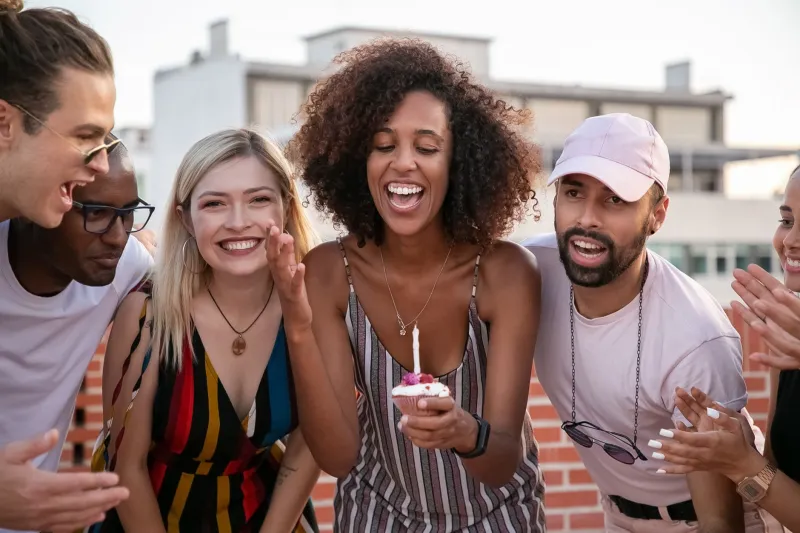
Here's the practical angle, because Eenyakee is nothing if not useful: if you're throwing a party and you want people to actually connect rather than stand in separate pods staring at their phones, introduce a chant. Seriously.
It doesn't have to be complicated. A call-and-response drinking game. A counting-out ritual to decide who picks the next playlist song. A group chant to kick off a toast. The content barely matters — what matters is the synchrony. Get people saying the same thing at the same time, and the social temperature in the room will rise noticeably within minutes.
Event planners and social psychologists who study group dynamics have noted that rituals — even brief, silly ones — dramatically increase feelings of group cohesion. The sillier, arguably, the better. Shared absurdity is bonding on a turbo setting.
Build Your Own Viral Chant: A Completely Serious Guide
Okay, you want to create the next big chant. Here's what the research (and our own deeply unscientific experimentation) suggests actually works:
1. Keep it short. Six to ten syllables max. If people can't memorize it in one listen, it's already dead.
2. Build in a rhythm that wants to be clapped. The physical element activates more of the brain's motor system, deepening the bonding effect.
3. Include a call-and-response structure. One person (or group) says a line; another responds. This creates active participation rather than passive recitation.
4. Make it slightly absurd. Nonsense syllables, unexpected word choices, and playful sounds are more memorable and more shareable than "normal" language.
5. Give it a natural endpoint. Chants that trail off awkwardly die. Build in a clear finish — a final beat, a punch word, a gesture.
The eeny meeny rhyme, if you look at it through this lens, checks every single one of these boxes. It's short. It's rhythmic. It has a call-and-response quality. It's delightfully nonsensical. And it ends with a clear, decisive point. No wonder it's survived centuries.
The Takeaway (Or: Why You Should Start a Chant at Your Next Gathering)
We came into this story thinking we'd write something fun about group chanting and walk away with a few interesting facts. We came out the other side genuinely moved by how deeply wired humans are for this stuff. We are, at our core, a species that bonds through rhythm. Through repetition. Through the act of making sound together.
Your kindergarten teacher knew it. Ancient tribal leaders knew it. Stadium designers know it. TikTok's algorithm has figured it out.
And now you know it too. So next time you're in a room full of people who feel like strangers, start a chant. Something small. Something silly. Something rhythmic.
Watch what happens to the room.
We dare you.